

Election Date Update
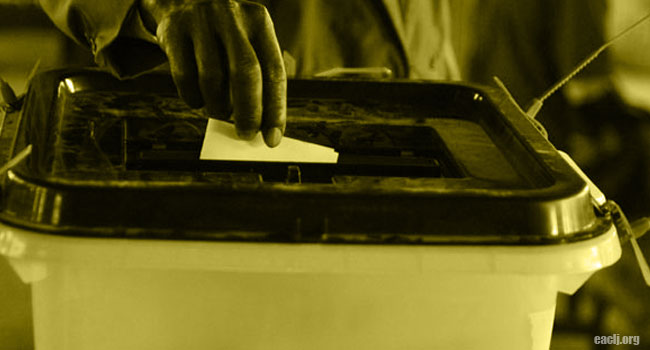
Kenyans expect the upcoming historical elections to be free and very fair; especially now that the Independent Electoral and Boundaries Commission (IEBC) has been formed to ensure the process runs well.
However the issue of the date when Kenyans will go to the polls still remains controversial, as suggestions to amend the constitution have been presented in Parliament.
The matter had earlier been forwarded to Kenya's newly constituted Supreme Court declined to give the directions on a date for next year's elections and instead forwarded it to the Constitutional and Human Rights Division of the High Court.
According to Article 163 (3) (a) of the constitution the Supreme Court has exclusive original jurisdiction to hear and determine disputes relating to the elections to the office of President. Under Article 140 a person may file a petition in the Supreme Court to challenge the election of the President-elect within seven days after the date of the declaration of the results of the presidential election. The election date issue is not such a matter and therefore does not trigger the Supreme Court's exclusive original jurisdiction.
Though the Supreme Court can make rules for the exercise of its jurisdiction under Article 163 (8), it appears the constitution intends that the Supreme Court be an appellate court or court of last resort. Article 163 (3) (b) states that the Supreme Court has appellate jurisdiction i.e. the power to review and change decisions from the Court of Appeal and any other court or tribunal. The Supreme Court can hear appeals in any case involving the interpretation or application of the Constitution. The Supreme Court can also hear appeals cases in which it, or the Court of Appeal, certifies is matter of general public importance, Article 163 (4).
As far as advisory opinions go, constitutionally the Supreme Court may give an advisory opinion at the request of the government or state organ with respect to any matter concerning county governments.
The case now rests with High Court which has jurisdiction to hear any question respecting the interpretation of the Constitution according to Article 165 (3) (d) of the constitution. Meanwhile, the speaker Kenneth Marende granted the justice minister Mutula Kilonzo the green light to formally introduce a Bill that seeks to amend the constitution and change the general elections' date.
According to the chairman of the recently formed IEBC Mr. Ahmed Isaack Hassan, having the elections conducted in August 2012 may not be possible as it is not practical. He cited numerous tasks that the IEBC Act says his commission must perform to prepare for the elections, and insisted that there is insufficient time to have the elections so soon.
Some of the tasks expected to be done are; the commission must study the report by the Independent Electoral Boundaries and Review Commission (IEBRC) and submit the findings to Parliament within four months, which is subject to revision in case Kenyans reject it. The commission must also hire and train staff, declare boundaries for constituencies and wards, conduct voter education and registration and procure computers before the elections are conducted.
Hassan stated, "The choice of date is not for political reasons but for practicality, because the new Constitution demands that all these tasks to be performed." Although this is contrary to what the chairman of Constitutional Implementation Commission (CIC) Charles Nyachae has been advocating for by challenging the IEBC over the exact date of elections, the ICJ programme Officer Elsy Saina stated that "As much as the law is there, the Supreme Court should consider the overriding interests of the public."


