Here are the broad strokes why the church is saying No
Article 2 (6) - The provision that International Conventions and protocols ratified by Kenya form part of the constitution under this constitution is mischievous. We must have a constitution that provides for domestication so that the Kenyan people, through parliament, have a chance to agree with international proposals, or to reject them. We cannot entrust the whole countries law making to one delegation of some international meet. Domestication of all international conventions, protocols and treaties must be maintained.
Article 8 - the problem with this section is what has been deleted, rather than what has been written. The deletion of "State and Religions shall be separate" as well as "All Religions shall be equal" makes things so hazy, where clarity is possible. why would the constitution not clearly state that all religions are equal, unless of course, it is because there are some religions that deserve better treatment than others, or other religions that really do not matter, and can be put down. The principle of separation of State and Religion is primarily for the protection of religion from the interference by the State. However, in recent times, tables have turned to see Religion infiltrating State, leading to religious standards being imposed on society, whether or not they ascribe to the faith. This is one provision that MUST be unequivocally stated.
Article 14 (4) - Today, Kenyan children cannot do their KCPE without birth certificates. More and more children are registered at birth, and the rate is increasing. For a constitution for posterity, it is curious to find out for whom this provision is made. The UNHCR estimates Kenya has over 340,000/= refugees. There are more who are not registered with the UNHCR but are present in the country. It is their children who are unlikely to be unknown. The use of the word "Nationality" in that sub-article is a dead giveaway. It means, even when physically the child resembles people of a certain nationality, the assumption will still hold. The granting of "citizenship by birth" is also suspect, since it is irrevocable. We recommend if this article must remain it be only for "citizenship by registration" which is revocable if fraud is found, rather than by birth, which is irrevocable.
Article 24 (4) - the exemption of one section of society from protection from discrimination simply because of faith in an unconstitutional provision. When the sources of law of Kenya are listed, all the laws are subjected to the constitutionality test, meaning, if they are inconsistent with the constitution, to the extent of the inconsistency, they are null and void. Sharia is not recognized as one of the sources of law of Kenya; however, there are exceptions to provisions of equality. With society moving towards making society more open for everyone, it is curious that the MOTHER LAW of Kenya advocates for sections of society to be openly discriminated against on the basis of religion.
Article 26 (4) - Dubbed the Abortion Clause. This Article should deal with everyone's right to life, including that of the unborn. Yet it goes to put the circumstances when an abortion is permissible. It begins by relaxing the caliber of those who can offer abortions to any health professionals who may include nurses, midwives, community health workers, clinical officers. The delicate procedure of an abortion to be entrusted to anyone is preposterous! It will definitely see an increase in maternal death, not a decrease. Secondly, the provisions of saving the life or health of the mother are deceptive. In Kenya today, women who are at risk of life threatening miscarriages, Rhesus factor affected pregnancies; ectopic pregnancies are saved without the life of the child taking precedence. However, when the health of the mother is a consideration, we find mischief. By definition, pregnancy is a very unhealthy experience for the mother, and child birth is actually life threatening. With Article 26(3) in the event in future if society accepts abortion, it may be legislated under that section. See http://www.plannedparenthood.org/about-us/international-program/kenya-country-program to further understand why abortion is even in our constitution to begin with.
Article 32 - Freedom of conscience has been whittled down to merely believing and manifesting ones beliefs. The freedom for one to change their religion and to propagate their religion has been removed. Moreover, the freedom to establish institutions fully sponsored by religious groups with one of the aims being the propagation of their religion has also been removed. The provisions for institutions to be able to restrict access to employment and to admissions in their institutions for the primary benefit of their religious faithfuls has also been removed. Why was section 78 of the current constitution not copied verbatim into this new constitution?
Article 170 - Kadhi Courts have been ruled by the constitutional court to be discriminatory. A reading of section 170 reveals that they are religious courts, not judicial ones, and so they ought to be left out of the constitution. The officers of these courts can only be Muslims, and no amount of study of Islamic sharia can make a lawyer qualify as a Kadhi unless he first profess the Islamic faith. All other Kenyans are served by an able judiciary in all personal matters. There is no reason why the constitution should discriminate against all Kenyans in favor of one faith, and even for those in the faith, discriminate against those who submit to kadhi's courts in light of Article 24(4).
Article 257 - Amendment of the constitution by popular vote is not only an unnecessarily long process, it is actually super-expensive in terms of time and money. Further to that, it is in the hands of the wananchi only for the purposes of collecting signatures. After that, the process is handed back to the Electoral Commission, and then is sent to the politicians. Amendment by popular vote should be the million signatures; a bill drafted, and is sent straight to a referendum. NO SINGLE politician should have a say as to whether it passes or not, it should be people driven all along! If politicians want to change the constitution, they should do it as per Article 255 and 256.
Article 34 - this brand new fundamental "right" dubbed freedom of the media is preposterous. It leaves Government with no control over media at all, even in events of National Security. The only role of the State is in licensing the airwaves, after that the media is left up to its own devices. With the role media plays in setting the agenda and in information dissemination, this is a provision that can be abused way too easily. It also explains why the media houses are also leaning on the passing of this proposed constitution. The Media Owners Association is one of Kenya's biggest and well concealed Cartels, and should be subjected to the provisions the Restrictive Trade practices and Monopolies law.
On a spiritual note, the inability of the church to PROPAGATE religion and the lack of protection for those who choose to CHANGE their religion means that the church will be emasculated. Christianity is the only religion that grows by convincing people to leave their old ways and follow Christ. Even our children have to make their own decisions to follow Christ, by saying the sinner's prayer, or by taking Communion or Eucharist, or be baptized. Christianity will be the most affected by the removal of these provisions, since without the Great Commission, the church is ineffective and useless, salt that has lost its saltiness. Secondly, if as a society we open the door for abortions, we as a society will pay a price for it. God will require of us the blood of those children who perish innocently, since we know that the blood of Abel still speaks to this day of the injustice of Cain's Murder. We are God's people, we must blow the trumpet to warn the nation of the danger of shedding innocent blood.
These are part of the ten reasons why the church is saying NO to the proposed constitution.
-- Joy Mdivo
Executive Director East Africa Centre for Law and Justice
As Kenyans prepare for the coming General Elections, it is important to understand the roles of the people they will be voting for.
The Constitution of Kenya introduced Devolution; which is a concept that must be understood for it to be effective. Devolution of power is identified as a value and principle that should guide our governance system. As part of devolution, management and coordination of the functions of the county administration and its departments lie squarely with the county governments.
The centre of the County Government is the County Assembly and the County Executive. The former plays the role of lawmaking, while the latter carries out the governance functions of the county. These responsibilities are to be undertaken in line with the principles of good governance, as highlighted in the Constitution. It is therefore imperative to have the right people to manage these county governments in accordance with the constitution.
Article 176 of the Constitution seeks to define, explain and elaborate the arrangement, powers and functions of a County Government. It also clarifies the relationship between the County Assembly and the County Executive.
The Constitution provides for a County government for each County,
The Governor is the overall head of the County. The Governor is directly elected by the voters registered in every county, on the day of the general election. The County Government shall consist of:
a County Assembly;
a County Executive
The Executive authority of the County is vested in and is to be exercised by a County Executive Committee which consists of
A Governor;
Deputy Governor; and
Members appointed by the County Governor with the approval of the County Assembly, but who should not be members of the County Assembly.
Each candidate for election as County Governor nominates a person who is qualified for nomination for election as County Governor as a candidate for Deputy Governor.
The County Assembly on the other hand consists of:
members elected from each ward in the county by votes of the respective County Assembly Ward;
Members nominated by political parties in proportion seats received in the election in the county to ensure that no more than two thirds of the county assembly are of the same gender;
four persons with disability; and
four youth.
The County Assemblies being the legislative organ of the County Government are supposed to make laws for the county government; exercise oversight over the county executive organs; and receive and approve plans and policies for the Counties.
Election of county assembly members is very crucial in realizing the goals of devolution. Voters must ensure compliance with the integrity standards as captured in chapter six. Issues of integrity have generated a lot of controversies during this campaigning period; there are no clear guidelines on what criteria to use on determining whether the integrity threshold has been met. It is therefore upon the citizens to go and register as voters to ensure that the right people are voted into this county government. We urge the people entitled to vote to question the track records of aspirants and examine them carefully before entrusting them with leadership.
Following a public outcry against the alarming rate of impunity within our country's Judicial system, the Judges and Magistrates Vetting Board (JMVB) was instituted, subject to the Sixth Schedule, section 23 of the Constitution in order to clean up the mess that had been existing for a long time!
The schedule provides as follows:
"Within one year after the effective date, Parliament shall enact legislation...establishing mechanisms and procedures for vetting, within a timeframe to be determined in the legislation, the suitability of all judges and magistrates who were in office on the effective date to continue to serve in accordance with the values and principles set out.....
A removal or a process leading to the removal, of a judge, from office by virtue of the operation of legislation contemplated under subsection (1) shall not be subject to question in, or review by, any court."
Section 21 and 22 of the Vetting of Judges and Magistrates Act stipulate that the Board shall, upon determining the unsuitability of a judge or magistrate to continue serving in the Judiciary, within thirty days of the determination, inform the concerned Judge or Magistrate of the determination, in writing, specifying the reasons for the determination. Once informed of the decision the Judge or Magistrate shall, be deemed to have been removed from service. Such a decision shall be made public. If dissatisfied by such a determination, the judge or magistrate may request for a review from the same panel within seven days. The Act is specific on the finality of the Board's decision.
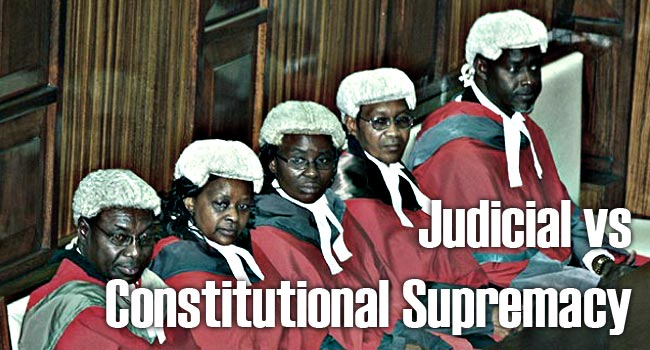
It is in this spirit that the Judges and Magistrates Vetting Board (JMVB) recently declared certain Judicial officers unfit to serve in the courts following reviews of their previous works and involvements in judicial misconduct. However, the High Court recently stated that it had supervisory jurisdiction over the vetting board which it claims to be an inferior body and consequently ruled that the board does not have the final word on the vetting of judges. The judges declared unsuitable include Riaga Omollo, Samuel Bosire, Joseph Nyamu and Jeanne Gacheche, among others.
The High Court was swift to stop the removal of four judges from office until their petitions before the Court are heard and determined. The court made this decision in an application filed by the Law Society of Kenya (LSK) seeking a determination on whether the court had jurisdiction to review decisions made by the vetting board. The Law Society of Kenya has the statutory mandate to, among other things assist the government in all matters affecting legislation and to protect and assist the public in Kenya in all matters touching on the law
In a similar application, the High Court ruled among other things that it shall have jurisdiction to intervene and review the process and decisions of the Vetting Board. As a consequence, some of the Judicial Officers determined as unsuitable may continue to write judgments and deliver rulings that had been left pending. LSK views this ruling and judgment as unacceptable and unconstitutional.
Owing to this, there has been interplay of many questions and clashing opinions from different parties. The Law Society of Kenya has termed the High Court ruling as a backward step in the efforts to clean up the Judiciary. They want the Court of Appeal to determine if High Court has the authority to supervise and handle matters arising from the vetting of judicial officers.
LSK has further called upon its members to wear yellow ribbons that will be distributed at the court stations to protest the continued interference with the vetting process by the courts and urged its members as well as the public not to appear before judges declared unfit by the JMVB. The Society terms the continued interference with the vetting process by the Judiciary as harmful to the spirit of the Constitution which empowers JMVB to vet judges and magistrates.
The move by the High Court is seen to openly imply that it is superior to the Constitution despite the fact that the Constitution stipulates that the JMVB's decision is final. The provision can only be changed by a referendum or a two-thirds majority in Parliament. As such, an open doorway to the overruling of many Constitutional clauses by the High Court could have been created. This raises the fear that the Constitution may be disregarded and seen as a meaningless document.
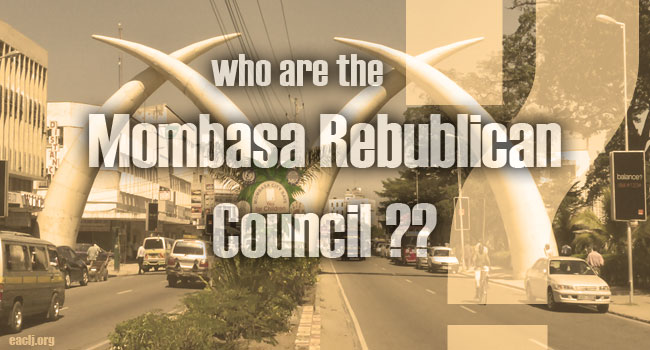
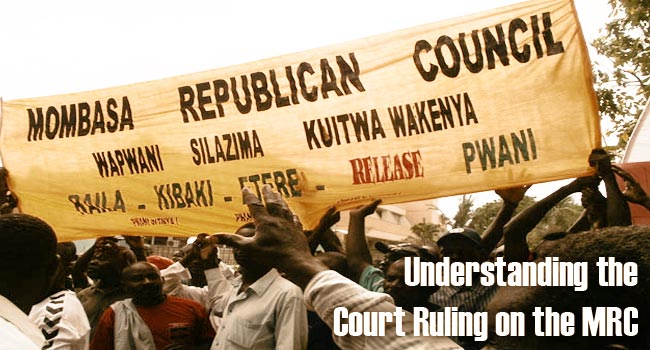
The Mombasa Republican Council (MRC) has recently resurfaced in the media spotlight again after the government arrested some of its suspected members during an alleged oathing ceremony in Likoni, Mombasa County. It is not surprising that the MRC has frequently been getting in trouble with the law as it was among the 33 groups that were declared 'illegal organized criminal groups' by the Government of Kenya through a Gazette notice issued last year (2010) October. So just who are the MRC? And exactly what are their motives?
The Mombasa Republican Council is a group based in the Kenyan Coast that was formed with the intention of righting what they believe to be wrongs done to the coastal people. Since its formation in the mid to late 90s, the MRC has had one clear agenda. Secession. The MRC spokesman Mohamed Rashid Mraja said they formed the movement to liberate the coastal region due to decades of alleged marginalization by successive governments. They make eerily similar claims to those brought forward by the shifta (Somali militia) who wanted to secede parts of North Eastern Province in the 1960s to be part of a 'Greater Somalia' – the shifta were eventually stamped out in a deadly confrontation that left several people dead.
History of the Coast Land Issue
Unlike the Shifta, the main issue the MRC has is land. The land problems in the coast can be traced back to 1887 when Seyyid Said leased the 10mile (16km) wide coastal strip to the Imperial British East Africa Company, which effectively made the coastal inhabitants squatters in their own land. In 1895 an agreement was made between Great Britain and Zanzibar under the supervision of Sultan Seyyid Hemed Bin Twain, Queen Victoria and the British Government in which Mombasa was to remain a protectorate under the British. The Sultan allowed the British Government to administer Mombasa for its Political and Business activities. This agreement stipulated that the sovereignty of Sultan would be maintained.
The story continues in 1962, just before Kenya got its independence. There were talks on whether or not this 1895 agreement should be altered. It was found that the coastal strip was not economically viable on its own and that the port of Mombasa was very important to Kenya and the East African region in general. So it was recommended that the Sultan be compensated and the region be made officially a part of Kenya. The recommendations also stated that the (then) new constitution recognize religious freedom that would allow the muslims the right to follow the Sharia Law in matters of religion and personal status. The Sultan was assured that the Sharia Courts would continue to function in Independent Kenya and that the authority of the Chief Kadhi would be preserved for Muslims in matters of personal status. When it came to a case between a Non Muslim and a Muslim, the general law would apply. So the Sultan agreed to give up his claims to the region. So in the 1963 Lancaster negotiations between the British and the Kenyans, the deal was sealed and the coast's hopes for autonomy vanished as well, despite the presence of the Mwambao United Front group – who wanted the option of being able to secede from Kenya and if possible join up with Zanzibar.
The government has since not revoked this agreement. Instead, after independence, all the land was transferred to the Government, which in turn gave the land to individuals who were not the original area residents. This happened when a law was passed that said that the first legislation of land will be valid and irrevocable regardless of how one acquired the title. So the elite and influential people in government at the time went ahead and registered themselves as the original owners of the land, an act that resulted in the coastal people becoming squatters in land they considered theirs.
The officials of the MRC claim to have documents that say that there was another 1963 agreement signed by the then Prime Minister Jomo Kenyatta and his Zanzibar counterpart Mohamed Shante. According to them, the agreement was a 50 year lease, which meant that the government was to return the region to the indigenous people... by 2013. The MRC Secretary General, Hamza Randu says this 1963 agreement integrated Mombasa as an independent region in the broader Kenya and that no part of it could be changed without the approval of the people from the protectorate.
The MRC Ideologies
As a result, the MRC says the coastal strip is not in need of any protection by the Kenya Government that was inherited from Colonial Britain. It says that it has in place a structured system, complete with a constitution, so it is ready to govern. The MRC officials also add that it is funded by top businessmen and politicians in the region (Mombasa).
The MRC is adamantly pushing for the partitioning of Kenya's territory, raising issues of marginalization, discrimination and neglect of the coast people. The MRC says it does not support the use of violence. The officials add that the members should not be considered rebels as they are only fighting for what they perceive to be their country – Mombasa. The MRC also say that theirs is an inter religious affair, because it affected all coast people, an assertion that was proven recently when the Pwani Church released a statement in support of what the MRC was doing.
The MRC states that despite the coast being a major contributor to the national economy (through the Port of Mombasa and Tourism in general), the coast people are yet to benefit from its resources and so they are under developed as a result.
The Current Constitution
The MRC has been declared unconstitutional because:
Although Article 36 of the constitution guarantees the freedom of association and assembly for every person, the intent and motive of the association that one is forming is very important so that one does not contravene the spirit of the constitution. The internal security minister pronounced MRC's motive to be parallel to the stability and unity of this country
The desire of the MRC to separate Coast Province from Kenya is unconstitutional and that is why they cannot be allowed to go on with their agenda. Article 3(2) of the constitution outlaws any attempt by anyone to form a government that is not inline with the constitution, which the MRC seeks to do.
Article 5 of the constitution strictly outlines the Kenyan territory to include territorial waters and territory of Kenya that was there on the effective date. So any attempt to change the territory of Kenya is unconstitutional and will not be allowed.
Effective date - is on 27th August 2010 when the constitution came into force as per Article 260.
Under article 60 of the new constitution, there is an attempt to address the past land injustices through the enshrinement of the principles of land policy. It provides that land shall be held, used and managed in a manner that is equitable, efficient, productive and sustainable in accordance to the following principles: equitable access to land; security of land rights amongst others.
Article 67 further establishes the National Land Commission whose functions amongst others includes initiating investigations on its own initiative or on a complaint, into present or historical land injustices, and then recommend appropriate redress.
Also, It is expected that the issues raised by the MRC will be duly tackled with the establishment of a devolved government, which is aimed at facilitating access to services. With the division of Kenya into counties, the constitution recognizes the right of communities to manage their affairs and further their development.
Conclusion
There seems to be light at the end of the tunnel because the Government has recently softened its hardline stance against the MRC by calling for dialogue. While the idea of seceding from Kenya is radical and should not be entertained, the Coast people may have some legitimate grounds for complaint. It is vital that the government seeks to actively address these issues especially those pertaining to land and porverty. No group of people in the country should feel marginalized in this day and age as we all work towards building a greater and more prosperous Kenya for all who live here.
Reforms in different institutions are among promises that came with the promulgation of the new constitution. With the recent report on the vetting of judges, Kenyans can comfortably say that this promise has been kept, at least in the Judiciary.
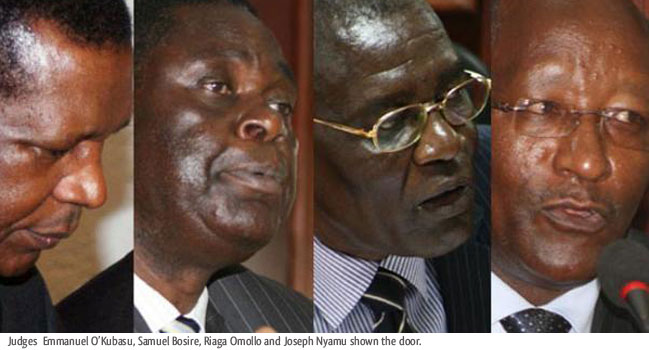
Four Court of Appeal judges were declared unfit to serve following reviews of their previous works and involvements in judicial misconduct. Chairman of the Judges and Magistrates Vetting Board, Sharad Rao, read out the names of the judges that had their careers end at the most unexpected time.
The named judges are among them, Justice Emmanuel O'Kubasu, who was accused of accepting "gifts" from litigants, Justice Riaga Omollo who was accused of authoritarianism on the Bench and inconsistency in his judgments of political cases. He also failed to show impartiality during the government of former president Moi. The case of Kenneth Matiba was cited where the judge castigated him in what was referred to as 'ungenerous, uncalled for manner', which manifested no sensitivity as he could have been paralyzed as a result of the torture. Justice Samuel Bosire was accused of condoning torture of suspects during 1982 coup trials. He was also indicted for failing to summon the former president who was adversely mentioned in the Goldenberg scandal when he served as chairman of the Commission of Inquiry into the multi-billion shilling scam. On his part, Justice Nyamu was accused of lacking professionalism, candour and was a stumbling block in the fight against corruption. In one instance, he issued a permanent stay against the prosecution of George Saitoti over the Goldenberg scandal.
The fact that the vetting was done in private has however raised the argument of whether the proceedings should be made public or not. This is still subject to discussion as Sections 19(2) and (5) of the Vetting of Judges and Magistrates Act have to be changed to allow for such a provision.
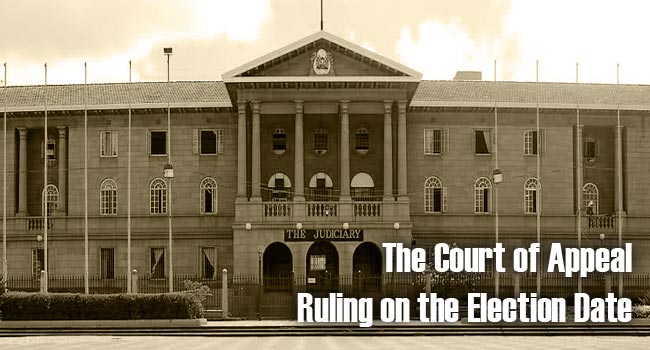
Last week Tuesday, the Court of Appeal upheld a lower court's decision to set the date of the upcoming general elections to be on 4th March 2013. The High Court had in January ruled that the polls should be held in March of the following year i.e. 2013. These polls have taken an extra significance because they will be the first to be held under the new constitution. They will also be the first since the poll election violence that rocked the country in 2007. As a result of the violence, two of the leading candidates, Uhuru Kenyatta and William Ruto, have a case to answer at the International Criminals Court (ICC). Kenya has traditionally held elections in December. The new constitution changed that in article 101(1) where it states that elections are to be held the second Tuesday of August in every fifth year. However, the next election date has been under debate essentially because of the new constitution, and also because of the sensitive nature of the coalition government, which came about as a peace compromise after the post election violence.
The now defunct Interim Independent Electoral Commission (IIEC) had gone to the Supreme Court seeking an advisory opinion interpreting Articles 101, 136(2) (a) 177(1) (a) and 180(1) of the constitution which deal with the general elections. They also wanted a further opinion as to when the next general election should be held. The Supreme Court then declined to give directions on the date of the next general elections and instead referred the matter back to the Constitutional Human Rights Division of the High Court. The Supreme Court ruled that it lacked the Jurisdiction to hear this matter... read more here.
Article 162 lists the systems of courts. The superior courts in the land are the Supreme Court, the Court of Appeal and the High Court (listed here in order of superiority). Article 163 gives the Supreme Court the ultimate power to hear and determine disputes relating to the elections with regards to the office of the President. It also has the power to hear appeals from the Court of Appeal. The Court of Appeal has the jurisdiction to hear appeals from the High Court and any other court or tribunal. The High Court has jurisdiction to hear any question respecting the interpretation of the Constitution... including the determination of:
The question whether any law is inconsistent with or in contravention of the Constitution;
The question whether anything said to be done under the authority of the Constitution or under the authority of any law, is inconsistent with or in contravention of the Constitution;
Any matter relating to constitutional powers of state organs in respect to county governments and any matter relating to the constitutional relationship between the levels of government;
So when the Supreme Court referred the matter to the High Court, Three High Court Judges, Justice Isaac Lenoala, Lady Justice Mumbi Ngugi and Justice David Majanja failed to declare a specific date for elections. They instead pronounced two scenarios on which the election date could be set.
➢ The President and the Prime Minister agree in writing to dissolve the coalition government
➢ The elections be held within 60 days after January 14, which would be when the term of the Tenth parliament expired.
The Independent Electoral and Boundaries Commission (IEBC) then set a March 2013 election date following the ruling. The March 4, 2013 date was, however, challenged by a section of the civil society (The Center for Rights Education and Awareness and the Caucus for Women's Leadership), which argued any extension of the election date could only be made through a constitutional amendment. The lobbyist then took the case to the Court of Appeal.
A ruling by a five-judge bench in the Court of Appeal upheld the March 4th date that had been set by IEBC. They supported the High Court's decision that the elections should be held within 60 days of the expiry of the current Parliament's term, which ends on the 14th of January 2013. The Court of Appeal Judges who supported the High Court ruling were Justice Erastus Githinji, Justice David Maraga, Lady Justice Hannah Okwengu and Justice Kalpana Rawal. Lady Justice Martha Koome however gave a dissenting opinion where she ruled that Kenyans should go to the polls before January 15 2013. According to her, the election date should fall within 60 days to the end of the term of the House. She felt that dissolving Parliament within 60 days after the expiry of their term, as interpreted by the High Court ruling, would extend the current Parliament's term beyond five years and this be in violation of the Constitution. Lady Justice Hannah Okwengu explained that the Constitution provides for Parliament to complete its term uninterrupted and that there was logic in the date set by the electoral commission as it would give candidates a chance to campaign.
The Court of Appeal ruling added that the President and the Prime Minister had no power to dissolve parliament and call for elections since the National Accord, which gave that power, ceased to exist when the new constitution was promulgated.
There would be no vacuum in government if elections were held in March 2013, since the President, Prime Minister and all the Cabinet would continue serving until a new government is appointed after the coming elections. This means that the next parliament would only sit for four years and four months.
The March 4th 2013 election date will stand unless someone further appeals to the Supreme Court, which has jurisdiction to determine appeals from the Court of Appeal. Although it is highly unlikely that the Supreme Court would overturn this decision, one of the human rights groups that had filed the petition for elections to be held at an earlier date said it is considering appealing the ruling.
The Constitution of Kenya 2010 establishes two levels of Government:
The National Government
The County Government
Each of these levels is charged with specific responsibilities. Each level is also provided with public institutions that will enable it to perform its functions.
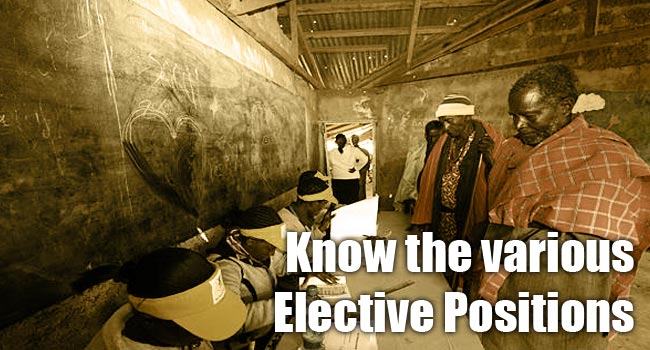
The Constitution empowers the people to exercise sovereign power directly through elections. Power is exercised at both the Central and County Governments on behalf of the people. For leaders to genuinely exercise power on behalf of the people, they must be elected democratically in free and fair elections. Elections enable the people to exercise their right to the freedom of making political choices.
Elective Positions
There are six elective positions:
The President (elected with their Deputy)
The Member of the National Assembly
One woman elected to the National Assembly by voters in each county.
The Governor (elected with their Deputy)
The Senator
The Ward Representative
In the election of the President and Governor, a Deputy President and a Deputy Governor will also be elected in the same ballot. However, there shall be no separate election for the Deputy President and Deputy Governor but they will be declared elected if the candidate who nominated them as running mates wins the elections. The Deputy is also referred to as the running mate.
The President, the Deputy President and the Cabinet are members of the National Executive. The Legislature also known as Parliament is made up of members of the National Assembly including 47 women elected from each county and Senators.
The Governor and Deputy Governor form the County Executive while the County Ward Representatives constitute the County Legislature known as the County Assembly.
The President and the Deputy President will head the elective positions at the National Government level.
A candidate only wins the Presidential Election if he/she receives:
More than half of all the votes cast in the election; and
At least twenty-five per cent of the votes cast in more than half of the counties.
In case no candidate is elected, a fresh election between the two top candidates will be held within the next thirty days. This second round of elections is referred to as the run-off election. The candidate who receives the most votes in the fresh election will then get declared as President within seven days.
Two years ago, the Minister of State for Provincial Administration and Internal Security, the late George Saitoti, published a Gazette Notice (No. 12585) which stated that the Mombasa Republican Council (MRC) is an organized criminal group that was unconstitutional. Despite all the controversy surrounding them, the MRC filed a petition to the court seeking determination on whether or not they should be considered unconstitutional.
Subsequently, after a careful assessment of the facts at hand and the position of the law, the High Court has now lifted that ban on the Mombasa Republican Council, effectively giving them license to pursue their agenda - as long as they remained within the confines of the law.
The Articles in the Court Ruling
The Court put into consideration various provisions in The Constitution in arriving at this decision.
Article 36 (1), which expresses the freedom of association, was cited by the Court. It states as follows:
"Every person has the right to freedom of association which includes the right to form, join or participate in the activities of an association of any kind."
Article 37 on assembly:
"Every person has the right, peaceably and unarmed to assemble, to demonstrate, to picket, and to present petitions to public authorities."
Article 38 (1) on political rights:
"Every citizen is free to make political choice, which includes the right:
to form, or participate in forming a political party.
to participate in the activities of, or recruit members for, a political party; or
to campaign for a political party or cause."
Article 24 (1) provides as follows:
"A right or fundamental freedom in the Bill of Rights shall not be limited except by law, and then only to the extent that the limitation is reasonable and justifiable in an open and democratic society based on human dignity,
Equality and freedom, taking into account all relevant factors, including –
the nature of the right or fundamental freedom;
the importance of the purpose of the limitation;
the nature and extent of the limitation;
the need to ensure that the enjoyment of rights and fundamental freedoms by any individual does not prejudice the rights and fundamental freedoms of others; and
the relation between the limitation and its purpose and whether there are less restrictive means to achieve the purpose."
The court pronounced that the evidence was insufficient to prove MRC's connection to violent crimes and added the group may agitate its agenda through political and legal means. Contrary to their expectations, MRC's chants, slogans and "agitation for secession" might constitute hate speech, propaganda for war, incitement to violence or advocacy for hatred, which is "unconstitutional and criminal", as stated by the Court.
Secession
The group has been warned against demanding secession for the coastal strip or dismembering the country or even inciting hatred. The Court ruled that according to Article 5 of the Constitution, more territory can be added or included to what currently comprises Kenya and that the Article does not suggest that Kenya can lose or cede any part of its territory.
Article 5 of the Constitution provides:
"Kenya consists of a territory and territorial waters comprising Kenya on the effective date, and any other additional territory and territorial waters, as defined by an Act of Parliament."
The Ethiopian Constitution for example expressly provides for secession and thus envisages secession by declaring this under Article 39 of their Constitution:
"Every nation, nationality and people in Ethiopia has an unconditional right to self determination, including the right to secession."
But in Kenya, the right to secession can only be achieved by an amendment to section 5 of the Constitution. An amendment to the Constitution would require a referendum.
Despite this ruling, MRC still remains adamant in its push for secession.
Article 27(8) of the Constitution stipulates that the state shall take legislative measures to implement the principle that no more than two-thirds of the members of the elective or appointive bodies shall be of the same gender. 81(b) further states that not more than two-thirds of elective public bodies shall be of the same gender.
These provisions among others are for the purpose of achieving gender parity in all elective or appointive posts of the state.
A racket has already began brewing concerning the two-thirds gender rule as the possibility of an impossibility arises in striking or arriving at this balance.
If more men are elected, which is the most likely case, each county will be required to bring in nominated women members to ensure that the one-third gender rule is attained as provided for in the Constitution. Additional multitudes of house members means that additional costs will be inevitable; costs which the taxpayer has to meet- as stated by the Commission on Revenue Allocation. The commission has estimated that Kenyans will have to pay Sh4billion as the gender rule crisis looms.
Below is a summary of what the National and County the governments will comprise of:
The National Government
The National Government comprises of a parliament which shall consist of the National Assembly and the Senate.
The National Assembly consists of:
290 elected members to represent constituencies.
47 women elected by voters to represent each county
12 members nominated by parliamentary political parties.
A speaker, who is an ex officio member.
The Senate consists of :
47 members elected from each county
16 women nominated by parliamentary political parties.
2 youth representatives.
2 persons representing the persons with disabilities
A speaker, who is an ex officio member.
The County Government
It is comprised of the County Assembly and the County Executive Committee.
The County Assembly consists of:
The 47 counties will elect 1,450 lawmakers countrywide, according to wards demarcated by the Independent Electoral and Boundaries Commission.
Each County shall have the number of special seat members necessary to ensure that no more than two-thirds of the membership of the assembly are of the same gender.
Members from marginalized groups including persons with disabilities and youth as described by an Act of Parliament.
A speaker, who is an ex officio member.
The County Executive Committee consists of:
County Governor
Deputy County Governor
Members appointed by the county governor whose number will be one-third of the members of the county assembly if the assembly has less than 30 members or ten, if the assembly has more members.
Although the 10th parliament was so keen on consolidating its position by providing for a mechanism to ensure this is achieved in the Senate and in the County Assemblies, it left the National Assembly open.
A Bill to amend the Constitution to provide for top-up nominations in case elections fail to provide the one-third gender rule will be tabled in Parliament. The Bill seeks to amend the Constitution to effect Article 27 (8) and 81(b). As of now, the Parliament is under the pressure of various stakeholders to implement the gender rule as failure to do so will cause a constitutional crisis.
It is critical to have a legislation that will ensure that there is gender equity and fair representation in the National Assembly and the Senate as well as the County Government.
Various suggestions have been deliberated to help solve this crisis and beat the one-third-gender rule. One includes the scrapping of all Constituencies to remain with the Counties as the only elective units. Another proposal is that each county elects two women representatives instead of one. This would bring the number of elected women to 94 and the rest would be met through other means.
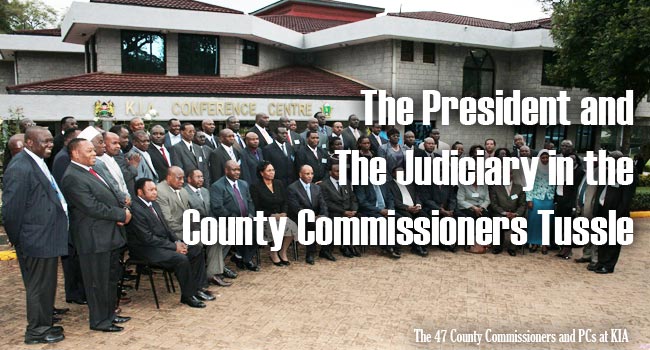
Recently, the president appointed 47 county commissioners to carry out various national tasks in the already established counties. This was aimed at coordinating the national government functions at the county level. The distinct functions of the commissioners include coordinating security management; coordinating national government functions and delivery of services; facilitating conflict management and peace-building; mobilizing national government agencies for national events, and programmes.
This move by the president was backed with Section 17 of the sixth schedule of the Constitution which states that:
"Within five years after the effective date, the national government shall restructure the system of administration commonly known as the Provincial Administration to accord with and respect the system of devolved governments established under this constitution".
The appointments were met with firm opposition from various groups lobbying against this and they were not hesitant to file petitions in the High Court challenging the constitutionality of this. It was said that the appointments undermined national values and principles of governance that are contained in Article 10(2) (b) of the Constitution. These include human dignity, equity, social justice, inclusiveness, equality, human rights, non-discrimination and protection of the marginalized. The petitioners also faulted the appointments due to the president's failure to observe gender balance; failure to consult with the prime minister whenever appointments to senior Government offices are made which is in accordance to the spirit of the National Accord and Reconciliation Act 2008; and failure to seek parliamentary approval on the same issue. This move also contravened article 27 that stresses on the equality of all persons and freedom from discrimination.
The High Court declared these appointments as unconstitutional and consequently null and void. Lady Justice Ngugi held that the President did not have any powers to appoint the Commissioners and that even if he did; he ought to have consulted the Prime Minister. She further stated that the president cannot make appointments to positions that are non existent. It was pre-empted that this appointments would have put County Commissioners in conflict with the governors.
Despite the Court's ruling, the commissioners are still in their new offices allegedly discharging their duties. It is as though the High Court's revocation of the appointments has been ignored. This has occasioned a tussle of supremacy between the president and the Judiciary as the commissioners function in the Ministry of State for Internal Security that is under the presidential docket. The Justice Minister has asked the President to officially nullify the appointment of the 47 officers urging the government to lead by example and show respect for the rule of law by respecting the institutions that have been put in place. The Attorney General has also advised against appealing the court's decision. The Law Society of Kenya (LSK) has said that it will apply for sanctions against the County commissioners still in office to be cited for contempt of court, reminding the Executive that nobody is above the law. The Internal Security and Provincial Administration Minister has ignored legal advice by the Attorney General and has now wants to commence an appeal against the High Court decision that declared County Commissioners illegal.
The question that now remains in this new constitutional dispensation is whether judicial sovereignty is still an existing principle.